- English
- French
- German
- Portuguese
- Spanish
- Russian
- Japanese
- Korean
- Arabic
- Greek
- German
- Turkish
- Italian
- Danish
- Romanian
- Indonesian
- Czech
- Afrikaans
- Swedish
- Polish
- Basque
- Catalan
- Esperanto
- Hindi
- Lao
- Albanian
- Amharic
- Armenian
- Azerbaijani
- Belarusian
- Bengali
- Bosnian
- Bulgarian
- Cebuano
- Chichewa
- Corsican
- Croatian
- Dutch
- Estonian
- Filipino
- Finnish
- Frisian
- Galician
- Georgian
- Gujarati
- Haitian
- Hausa
- Hawaiian
- Hebrew
- Hmong
- Hungarian
- Icelandic
- Igbo
- Javanese
- Kannada
- Kazakh
- Khmer
- Kurdish
- Kyrgyz
- Latin
- Latvian
- Lithuanian
- Luxembou..
- Macedonian
- Malagasy
- Malay
- Malayalam
- Maltese
- Maori
- Marathi
- Mongolian
- Burmese
- Nepali
- Norwegian
- Pashto
- Persian
- Punjabi
- Serbian
- Sesotho
- Sinhala
- Slovak
- Slovenian
- Somali
- Samoan
- Scots Gaelic
- Shona
- Sindhi
- Sundanese
- Swahili
- Tajik
- Tamil
- Telugu
- Thai
- Ukrainian
- Urdu
- Uzbek
- Vietnamese
- Welsh
- Xhosa
- Yiddish
- Yoruba
- Zulu
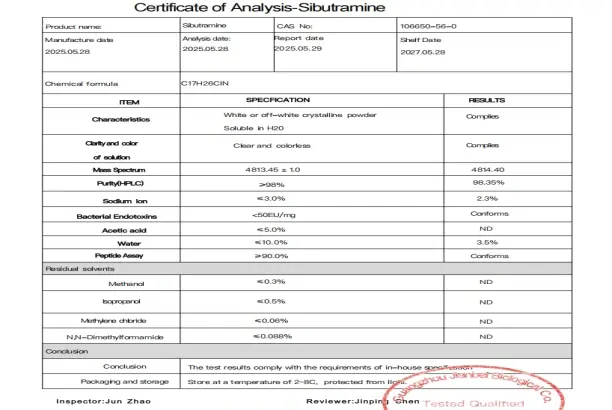
When sourcing weight management APIs for pharmaceutical or supplement formulations, securing validated documentation becomes non-negotiable. Sibutramine Powder—a white crystalline compound with molecular formula C17H26ClN and CAS number 106650-56-0—requires rigorous certification to meet international procurement standards. The Certificate of Analysis (COA) serves as your primary quality verification tool, confirming 98% purity via HPLC testing while documenting critical parameters like heavy metal content, microbial limits, and batch traceability. Beyond COAs, compliance certificates such as GMP, ISO, HALAL, and HACCP validate manufacturing practices across pharmaceutical, food, and cosmetic applications. This guide walks you through essential certification requirements, supplier evaluation tactics, and practical procurement strategies to streamline your B2B sourcing decisions.
Understanding Sibutramine Powder Certificates and Their Importance
Quality control is very important in the market for weight management ingredients, especially for active pharmaceutical ingredients like sibutramine hydrochloride monohydrate. Certificates act as gatekeepers to support your supply chain with documented quality, regulatory alignment, and formulation consistency.
What Is a Certificate of Analysis and Why Does It Matter?
A COA shows that your supplier has checked the quality of each batch of products. This lab-made document proves that the sibutramine crystalline powder is what was said it would be—usually 98% pure with a molecular weight of 279.85 g/mol. We've seen that real COAs have chromatography data that shows retention times, impurity profiles with limits below 1%, and leftover solvent analysis. The document should talk about tests that were done in a controlled laboratory setting, such as HPLC for potency, GC for solvents, and ICP-MS for heavy metals. When makers give you batch-specific COAs with unique lot numbers that match the numbers on your shipping labels, you can keep track of your goods, which is required by FDA checks and customs inspections. This paperwork is especially important when making solid dosage forms for oral use, where milligram-level accuracy determines how well the medicine works and how safe it is for the patient.
Key Regulatory Compliance Certificates for Global Markets
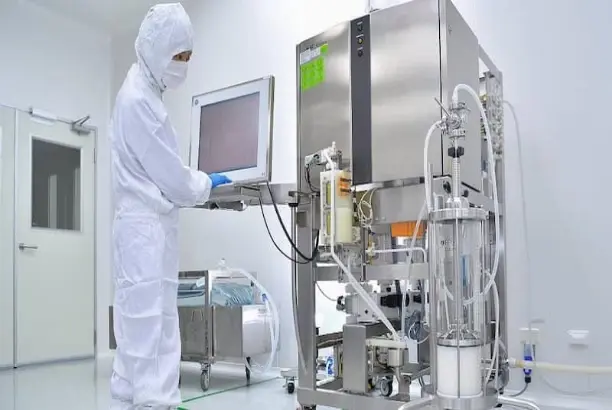
Systemic certifications show that your supplier follows well-known quality standards and goes beyond batch analysis. GMP approval proves that products are made in controlled settings using proven methods. Our factory has GMP-standard workshops with two separate labs checking the quality of all three production lines in real time. ISO certifications, especially ISO 9001 for quality management and ISO 22000 for food safety, are standards for operational success that are accepted all over the world. Buyers who want to sell in Europe should make sure they follow REACH rules, which limit dangerous chemicals and require registration paperwork. Meanwhile, HALAL and Kosher certifications open up channels of distribution within certain groups of customers, giving you more business options when it comes to where you get your ingredients. All of these certifications are kept up to date at our headquarters in Guangzhou Software Park, which is also backed by 15 national invention patents that cover the processes of core extraction and purification. All of these qualifications make it easier to be audited and speed up the customs clearance process in North American, European, and Asian trade zones.
How do certificates support procurement quality
Professionals in procurement are always under pressure to find the best mix between quality control and cutting costs. Three major areas of quality and compliance are supported by comprehensive certification portfolios. When third-party-confirmed COAs show documented quality parameters (heavy metals below 10 ppm, microbial counts within pharmacopeial limits, and formulation-related specifications), quality consistency is easier to verify. Regulatory compliance is easier to verify when providers provide paperwork that matches the needs of the final market. As an example, our service that focuses on exports includes customized certificate packages that meet FDA, Health Canada, and EFSA standards. Documenting the shelf life (our Sibutramine Powder stays stable for 24 months when kept in a dry, cool place) and validating the packaging (we use 1 kg aluminum foil bags and 25 kg fiber drums that keep the product's integrity during international shipping) makes supply chain management easier to handle. With this certification infrastructure, choosing a supplier is no longer a guessing game but a data-driven process.

Core Compliance Requirements for Sibutramine Powder Suppliers
Manufacturing, safety, and legal standards must be followed in order for sourcing partnerships to be reliable. Knowing these standards helps you weed out vendors who aren't qualified before you sign a deal with them.
Mandatory Quality Control Documentation
Suppliers that are legitimate have full quality management systems that create paperwork at every stage of production. You should get batch production records that show where the raw materials came from, how they were processed, and the temperatures used during the purification cycle. Recordings from in-process tests should include important control points like pH levels during crystallization, particle size distribution after grinding, and moisture content after drying. Our facility tests at three different points: when the raw materials come in (to make sure the botanical source is pure), when the process is halfway through (to check the extraction yield and intermediate purity), and when the finished product is released (to check the full COA panel, which includes appearance, assay, impurities, and microbial testing). According to ICH guidelines, stability studies show how the powder works in different temperature and humidity conditions, which can help you decide how to store it. Samples that are kept for at least one year after their expiration dates can be used as evidence in quality disputes. This ecology of paperwork is especially helpful when adding the ingredient to clinical-grade products or answering questions from regulators.
Safety Data Sheets and Legal Compliance
Safety Data Sheets (SDS) go along with analytical certificates because they explain how to handle, store, and handle an emergency. A valid SDS has 16 sections that follow the GHS format. These sections describe the chemical's properties, how to treat injuries, and how to properly dispose of the substance. Because sibutramine works as a serotonin-norepinephrine reuptake inhibitor and affects pathways in the central nervous system, it is important for people who use it later to understand its handling and storage requirements. We provide SDS documents in several languages that are specific to the countries where your goods are going. This way, your receiving teams will know how to store them properly (in a dry place, at a controlled room temperature, and away from substances that aren't compatible). Legal compliance also includes trade classification. Using the right HS codes makes clearing customs easier, and registering controlled substances (if needed) keeps shipments from being seized. Our export service includes pre-shipment compliance checks that look for possible regulatory mismatches between the source and destination countries. This keeps your purchase timeline from getting pushed back by delays you didn't expect.
Regional Certification Variations
Different licensing requirements set the standards for how suppliers can be qualified in global markets. North American buyers often put FDA registration and following USP monographs at the top of their list of priorities. They value suppliers who can provide Drug Master Files (DMFs) to support IND or NDA submissions. When buying things in Europe, REACH registration numbers and following EU Regulation 1223/2009 for cosmetics or EU Regulation 2015/2283 for new food ingredients are very important. Asian markets might need registrations that are special to each country, like a Health Canada license for sales in Canada, TGA compliance for sales in Australia, or CFDA alignment for operations in mainland China. Our main focus is on export markets, and we keep certification packages that meet all of these different needs by working together with regulatory experts in important trade areas. When you're evaluating suppliers, ask for proof of market-specific compliance instead of generic quality certificates. This shows how sophisticated their operations are and makes it easier for you to translate regulations.
How to Evaluate and Select a Trusted Sibutramine Powder Supplier?
Your choice of Sibutramine Powder supplier affects whether the development of your formula goes smoothly or runs into expensive quality problems. A structured evaluation framework supports your investment and increases the supply's long-term resilience.
Verifying COA Authenticity and Validity
Certificate theft is still a problem in the business, so buying teams need to have the skills to check. Real COAs have marks that show the testing lab is accredited (ISO/IEC 17025 is the global standard for testing competence), and they have the issuing lab's contact information on them. Compare the batch numbers on COAs with those on shipping papers and product labels. If there are any differences, it could mean that the documents were changed. If you are doing business with someone you don't know, ask for test reports directly from third-party laboratories. Reputable testing houses have client portals where you can use unique reference codes to make sure the reports are real. We welcome potential buyers to come see our factory in Guangzhou Software Park, which has three dedicated production lines and lets you see how our quality control works and meet the technical team that runs our GMP-certified business. During supplier audits, check to see if the COA data points match the product specifications. For example, if the claim is for 98% purity, the assay results should be between 97.5 and 98.5% (within analytical variation), not just convenient round numbers that could mean the data was made up. Pay attention to the times of the tests; COAs should be new and specific to the batch, not generic forms that are used for multiple shipments.
Comparing Supplier Certification Portfolios
Once the supplier's credentials have been proven to be real, look at how broad and useful they are for your application. Pharmaceutical companies should focus on getting GMP certification that has recent audit dates and covers more than just packaging operations when it comes to API production. Food and drink innovators need to have HACCP certification that shows they can do hazard analysis and manage critical control points. Cosmetic formulators can get better ingredients from suppliers who have ISO 22716 (cosmetic GMP) and stability study data that show how well the ingredients work in emulsion and gel systems. Our list of certifications includes FDA registration, ISO standards, HALAL, HACCP, and GMP qualifications. This variety shows that we can serve a lot of different markets from a single approved source. Check the supplier's technical support, too. Can they give you advice on how to make the product? Do they offer customized specs or changes to particle size? We have a skilled research and development team that can solve problems that are unique to each application. This makes us more than just a commodity seller; it makes us a formulation partner. Pricing models should also be carefully looked at. The cost-per-kilogram is important, but the total cost of ownership also takes into account things like the minimum order size (we can handle 1 kg starter orders), the ease of payment (we accept wire transfer, PayPal, and Western Union), and the dependability of delivery (our standard lead time is 3–7 working days after payment).
Industry Reputation and Performance Track Record
Peer insights can often show things about a supplier that certificates can't. Ask current customers in your industry for references. Hearing how a supplier manages supply requirements, quality standards, or helps to develop new products gives you a lot of useful information. Being at trade shows and being a part of industry groups shows that you are committed to professional networks and business standards. Since it started, our business, Jianbei Biotechnology Co., Ltd., has used its relationships in the biological products ecosystem to build a national branch network that supports efficient production and sales systems. Online checking of a business's validity through LinkedIn, trade association listings, and business-to-business markets is helpful; look for profiles of well-known companies with contact information that can be verified instead of storefronts that don't say who they are. Ask for case studies that show how the provider helped with formulation projects like yours; experience with specialized formulations, functional ingredient applications, or formulation research is a good sign of technical knowledge in this area. Remember that the best supplier strikes a balance between strict certification requirements and quick response times. Certifications show competence, but how well a partnership works depends on how well people communicate and solve problems.
Conclusion
To buy Sibutramine Powder, you need to find a balance between technical requirements, certification strictness, and regulatory awareness. The Certificate of Analysis is the main way to check the quality, but you should also look at seller certifications, pre-purchase tests, contractual terms, and customs paperwork as part of your full due diligence. By giving more weight to suppliers who show they follow good manufacturing practices (GMPs), have a wide range of certifications, and provide clear batch documentation, you can greatly improve the consistency of procurement while still supporting the success of formulation. As rules change and technology changes how quality is checked, working with well-known companies that have both the technical know-how and the infrastructure for compliance will become more and more valuable. Using the structured evaluation frameworks and verification methods explained in this guide will help you make confident purchasing choices based on data.
FAQ
1. What specific parameters should appear on a valid COA?
A full COA for Sibutramine Powder must include information about the powder's appearance (white crystals), its molecular weight (279.85 g/mol), its impurity profile (with unknowns below 0.1%), its heavy metal levels (below 10 ppm), the number of microbes that are within the limits set by the pharmacopeia, any solvents that meet the ICH Q3C guidelines, and the size distribution of the particles. Dates of tests, information about the lab's accreditation, batch or lot numbers, and approved signatures should all be on the paper.
2. How do certification requirements differ across major markets?
In North America, buyers stress FDA registration and USP compliance; in Europe, buyers demand REACH registration and EP monograph alignment; and in Asia, buyers demand approvals from health authorities in each country. GMP certification is still useful for everyone, but HALAL and Kosher approvals are more focused on certain groups of customers. Through our export-focused compliance program, we keep records that cover all of these different needs.
3. Can I request third-party testing before committing to large orders?
Yes, responsible suppliers do encourage third-party checks. We can provide samples (minimum 1 kg sales) upon request for the sole purpose of testing by clients. By sending batch-matched samples with corresponding COAs, we can make sure that our analytical claims are true before we start producing large amounts of our products. This builds trust in our quality systems.
Partner with Jianbei for Certified Sibutramine Powder Supply
With our wide range of certifications and focus on quality-first manufacturing, Jianbei Biotechnology Co., Ltd. takes away the guesswork from buying things. Our Guangzhou factory is GMP-certified and makes Sibutramine Powder that meets international standards. Every batch comes with full COA paperwork, ISO, HACCP, HALAL, and FDA registration. We have been making sibutramine powder for a long time and have three separate production lines and laboratories. We serve pharmaceutical, nutraceutical, and research customers who need reliable API sources. Our technical team helps with formulation, and our flexible terms—minimum orders of 1 kg, delivery in 3–7 days, and multiple payment options—allow for both pilot projects and large-scale production. Procurement managers who are looking for a sibutramine powder seller that is compliant are welcome to ask for samples and verification packages. Talk to us about your needs at sales@bqingbio.com to get the quality guarantee that comes with working with a biotechnology company that owns patents and is dedicated to "Innovation Driven by Technology, Health Protecting Life."
References
1. International Council for Harmonisation. (2021). Quality Guidelines for Pharmaceutical Development: ICH Q6A Specifications for Chemical Substances and Products.
2. United States Pharmacopeia. (2022). General Chapter 1086: Impurities in Official Articles - Testing and Acceptance Criteria.
3. European Medicines Agency. (2020). Guideline on Active Substance Master File Procedure—Quality Module Documentation Requirements.
4. World Health Organization. (2019). WHO Technical Report Series on Good Manufacturing Practices for Pharmaceutical Products: Main Principles.
5. FDA Center for Drug Evaluation and Research. (2021). Guidance for Industry: Drug Master Files Filing Procedures and Analytical Testing Documentation.
6. Association of Official Analytical Chemists International. (2023). AOAC Guidelines for Validation of Chemical and Microbiological Methods in Botanical Materials.