- English
- French
- German
- Portuguese
- Spanish
- Russian
- Japanese
- Korean
- Arabic
- Greek
- German
- Turkish
- Italian
- Danish
- Romanian
- Indonesian
- Czech
- Afrikaans
- Swedish
- Polish
- Basque
- Catalan
- Esperanto
- Hindi
- Lao
- Albanian
- Amharic
- Armenian
- Azerbaijani
- Belarusian
- Bengali
- Bosnian
- Bulgarian
- Cebuano
- Chichewa
- Corsican
- Croatian
- Dutch
- Estonian
- Filipino
- Finnish
- Frisian
- Galician
- Georgian
- Gujarati
- Haitian
- Hausa
- Hawaiian
- Hebrew
- Hmong
- Hungarian
- Icelandic
- Igbo
- Javanese
- Kannada
- Kazakh
- Khmer
- Kurdish
- Kyrgyz
- Latin
- Latvian
- Lithuanian
- Luxembou..
- Macedonian
- Malagasy
- Malay
- Malayalam
- Maltese
- Maori
- Marathi
- Mongolian
- Burmese
- Nepali
- Norwegian
- Pashto
- Persian
- Punjabi
- Serbian
- Sesotho
- Sinhala
- Slovak
- Slovenian
- Somali
- Samoan
- Scots Gaelic
- Shona
- Sindhi
- Sundanese
- Swahili
- Tajik
- Tamil
- Telugu
- Thai
- Ukrainian
- Urdu
- Uzbek
- Vietnamese
- Welsh
- Xhosa
- Yiddish
- Yoruba
- Zulu
When we talk about creatina bulk powders, we're talking about highly pure creatine monohydrate that is made in large quantities for business-to-business (B2B) uses like supplement formulation, wholesale distribution, and private label production. These finely ground, unflavoured powders are the main ingredient in sports nutrition products all over the world. By learning about the different types of creatine raw materials, buying teams, R&D leaders, and product managers can find ingredients that meet high-quality standards and help differentiate products and set competitive prices.
Introduction
To get around in the global sports nutrition supply chain, you need to know a lot about the main ingredients that make products work and do well in the market. One of the most studied and widely used performance-boosting substances in the supplement business is creatine monohydrate. When makers, distributors, and procurement workers look for a creatine provider, they need to look at things like purity requirements, legal compliance, production skills, and the stability of the supply chain.
This guide talks about the most important choices that business-to-business buyers in the nutritional goods, health supplements, and useful foods have to make. Whether you're making a new pre-workout powder, functional drinks with performance claims, or a private label supplement line, the quality of your creatine raw material has a direct effect on how well your products work, how safe they are, and how much trust customers have in them. This article will talk about compositional standards, procurement strategies, quality verification methods, and supplier evaluation criteria that can help you make smart decisions about where to buy things.
Understanding Creatina Bulk Powder – Key Concepts and Benefits
What Makes Creatine Monohydrate Essential for Sports Nutrition?
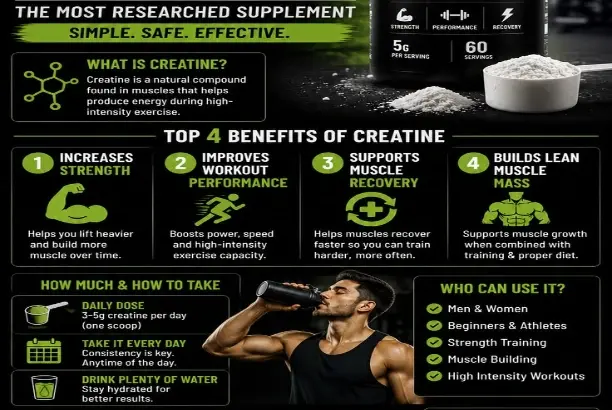
The amino acids glycine, arginine, and methionine are naturally made in the stomach, liver, and kidneys into the chemical creatine. Approximately 95% of creatine is stored in the body as phosphocreatine in skeletal muscle. During intense exercise, phosphocreatine gives a phosphate group to adenosine diphosphate (ADP), which quickly makes adenosine triphosphate (ATP), which is the main energy currency in cells. This biochemical process lets muscles keep up their power output during short bursts of intense activity like sprinting, lifting weights, or jumping.
Meat, fish, and dairy products are all dietary sources, but it's not practical to get performance-enhancing doses only from food. A normal meal gives you about 1 gram a day, but runners and other active people need 3–5 grams a day. This gap can be easily filled by supplements, and creatine monohydrate is the most cost-effective and scientifically proven form that can be used for bulk production.
Chemical Composition and Quality Specifications
Creatine monohydrate, which is made for professionals, looks like a white solid powder with the formula C₄H₉N₃O₂ and a chemical weight of 131.13. In regulatory and quality control records, this compound is identified by its CAS number, 57-00-1. For business-to-business purchases, the standard requirement is at least 98% purity, which can be proved by high-performance liquid chromatography (HPLC) testing.
There are more quality markers than just the purity number for creatine bulk powders. International safety standards must be met for heavy metals, microbes, and chemicals that are still present. The way something is made affects the presence of contaminants like dicyandiamide and thiourea, which are signs of bad synthetic pathways. Reliable suppliers give each production batch a Certificate of Analysis (CoA) that lists these parameters.
Performance Benefits for Target Applications
Taking creatine supplements has been shown to have benefits that make for strong product claims for consumer-facing brands. Harvard Medical School research shows that creatine improves athletic ability by helping the body make energy quickly during anaerobic activities. Because the compound encourages muscle cells to store glycogen, it helps the body heal faster after intense exercise.
Studies from Baylor Scott & White Health show that creatine is an important part of making ATP, which helps muscles work at their best for longer periods of time. Beyond its effects on athletic performance, a new study is looking into how creatine might help brain function, especially when people are mentally tired or don't get enough sleep. Product developers can use these different uses to come up with specific solutions for sports nutrition, functional foods, and wellness supplements.
Bulk creatine powder is good for business-to-business uses because it saves money. When manufacturers buy 25 kg drums instead of store packaging, they save money through economies of scale. Because the formula is flexible, it can be mixed with protein powders, amino acid complexes, or carbohydrate structures to make unique goods for before or after a workout. This flexibility helps with strategies for differentiating products that are important in supplement markets that are very competitive.
Choosing the Right Creatina Bulk Powder – Comparative Insights for Procurement
Comparing Creatine Forms for Large-Scale Manufacturing
Due to decades of safety and effectiveness research, creatine monohydrate is still the gold standard. Micronised creatine monohydrate goes through more steps to make the particles smaller, usually until they are 200-mesh fine. This makes the surface area bigger, which speeds up dissolution and eases stomach pain, all of which are good for customer satisfaction. Micronisation, on the other hand, raises production costs that buying teams have to weigh against the possible benefits of the product.
Different kinds, like creatine ethyl ester and creatine hydrochloride (HCL), say they are better at being absorbed or hold less water. The amount of scientific evidence supporting these claims is still not as strong as the research base for monohydrate. For business buyers who care most about following the rules and using evidence-based marketing, creatine monohydrate with a quality standard of 98% is the safest choice.
Buffered creatine products attempt to make them more stable at different pH levels. This might help with some formulation problems, but creatine bulk powder's standard monohydrate is very stable when stored the right way. When choosing between types, you should think about how you want to place your product, how much you want to charge, and what marketing claims your brand can back up with research.
Supplier Evaluation Criteria for Procurement Teams
To find trustworthy creatine providers, you need to carefully look at a lot of different factors. Certifications for manufacturing give you basic peace of mind. Look for facilities that follow GMP (Good Manufacturing Practice) guidelines and have ISO certifications that show they have quality management systems. International compliance is important for businesses that want to sell their goods abroad. Getting FDA registration, REACH compliance for European markets, and HALAL or kosher licences can help you enter more markets.
Stable supply and production capacity are very important for brands that want to grow their businesses. Suppliers with multiple production lines and large inventory buffers can handle changing order volumes and keep supplies from going down. Jianbei Biotechnology has three separate production lines in GMP-compliant workshops. They are backed up by two separate labs for quality control and research and development. This infrastructure makes it possible to consistently meet international standards while keeping lead times low.
Professional sellers and commodity traders are different in how well they can document their work. Full technical data sheets, batch-specific COAs, stability studies, and regulation support papers make it easier for you to develop your product and send it to the government. Suppliers with their own research and development (R&D) departments can help with formulation, test for compatibility, and come up with custom solutions that meet the needs of a specific product.
Purity Testing and Quality Verification Methods
HPLC testing is the standard way for the industry to check the amount of creatine and find any impurities. This analysis method sorts chemical compounds into groups based on how they react with a fixed phase. This makes it possible to measure them accurately. Reliable suppliers do HPLC analysis on every batch of production and give customers copies of the results, which are called COAs.
Heavy metals (lead, mercury, cadmium, arsenic), microbial contamination (total plate count, yeast, mould, E. coli, Salmonella), and solvents used during production should all be checked as part of the testing procedures. These parameters have acceptable ranges set by international standards like the USP (United States Pharmacopoeia) or EP (European Pharmacopoeia) monographs.
Moisture content affects how stable a product is and how much to use. One water molecule makes up about 12% of the weight of creatine monohydrate in its chemical structure. Too much moisture above this possible number means that the keeping conditions are bad or there are problems with the production of creatine bulk powders. Using Karl Fischer titration to accurately measure moisture content helps procurement teams make sure that storage rules are being followed.
Conclusion
In the sports nutrition supply chain, choosing the right supplier for creatine raw materials affects the quality of the product, compliance with regulations, and the ability of the business to make money. This guide has listed important things to think about when it comes to technical standards, quality control methods, seller evaluation criteria, and buying strategies. Creatine monohydrate is an essential ingredient for companies making competitive sports nutrition products because it works well and doesn't cost too much.
Achieving good procurement means balancing many factors, such as the purity of the ingredients, the dependability of the suppliers, following all the rules, keeping costs low, and being able to adapt the supply chain. Partnering with makers whose facilities are GMP-certified, who keep detailed quality records, and who offer quick technical help reduces risk and allows for new product development.
FAQ
1. What distinguishes micronised from standard creatine monohydrate powder?
After being micronised, creatine goes through more mechanical processing that makes the particles about 200 mesh fine. This makes the surface area bigger, which speeds up the dissolution of liquids and might make stomach pain go away. Standard creatine monohydrate works the same way when it comes to muscle creatine uptake, but it might need to be mixed more thoroughly. When making a procurement choice, you should think about whether the extra processing costs for better mixability are worth it for your goal of product positioning.
2. How can buyers verify creatine purity and prevent counterfeit products?
Ask for Certificates of Analysis that show that the HPLC test results are at least 98% pure. Check to see if there are manufacturer batch numbers that connect paperwork to products that have already been shipped. Third-party lab testing is a reliable way to make sure of something; choose approved labs that are familiar with the USP or EP creatine standards. Check the certifications of the supplier, such as GMP facility registration and ISO quality management systems. A visual check should reveal a white, crystalline structure that doesn't have any discoloration, clumps, or strange smells that could mean it is breaking down or being contaminated.
3. What factors cause clumping in bulk creatine powder during storage?
The main reason for clumping is being exposed to moisture. Creatine monohydrate takes in water from the air, which makes particles stick together. This problem can be avoided by storing things properly in sealed containers with desiccant packets in climate-controlled areas. Suppliers who use aluminium foil bags or drums with PE liners that are sealed well keep wetness out. If the product clumps, the quality may still be good as long as the total wetness content stays within the range allowed. However, changes in texture can affect how it is processed later on and how the customer feels about it.
4. What are typical lead times and minimum order quantities for bulk creatine procurement?
Standard production quantities are sent out 3–7 business days after payment is confirmed. Custom specs or micronisation processes could make delivery times longer. Different suppliers have different minimum order amounts. For example, Jianbei can handle orders as small as 1 kg for research and development, but most commercial orders start at 25 kg. Container-load amounts (10,000 kg or more) get better prices, but they need to be planned ahead of time so that production plans and shipping logistics can work together.
Partner with Jianbei for Premium Creatine Bulk Powder Supply
Jianbei Biotechnology provides pharmaceutical-grade creatine monohydrate that meets all international standards for making sports nutrition. Our building is GMP-certified and has three separate production lines. Each batch is tested using HPLC by an independent lab. We work with supplement brands, functional food developers, and private label manufacturers all over the world. Our products are at least 98% pure, and we have full certifications from the FDA, ISO, HALAL, and HACCP. Our minimum order quantities (MOQs) are also very low, starting at just 1 kg.
Our experienced research and development team helps with formulation, stability tests, and regulation paperwork. Large inventory levels ensure delivery times of 3–7 days, and competitive pricing structures work for all kinds of businesses, from new brands to well-known manufacturers. As a supplier of creatina bulk powders for a long time, we know what's important for businesses when they buy things: consistent quality, reliable supply, and quick technical service.
Contact our team at sales@bqingbio.com to discuss your particular needs. You can ask for samples, look at our full list of certifications, or look into the possibility of custom formulation.
References
1. Antonio, J., & Ciccone, V. (2021). "The effects of pre versus post workout supplementation of creatine monohydrate on body composition and strength." Journal of the International Society of Sports Nutrition, 18(1), 1-8.
2. Kreider, R. B., Kalman, D. S., & Antonio, J. (2022). "International Society of Sports Nutrition position stand: safety and efficacy of creatine supplementation in exercise, sport, and medicine." Journal of the International Society of Sports Nutrition, 19(1), 1-58.
3. Hall, M., & Trojian, T. H. (2020). "Creatine supplementation: Clinical applications in sports nutrition and medicine." Current Sports Medicine Reports, 19(7), 265-271.
4. Candow, D. G., Forbes, S. C., & Chilibeck, P. D. (2023). "Creatine supplementation and aging musculoskeletal health: A review of current evidence." Nutrients, 15(4), 891-908.
5. Rawson, E. S., & Volek, J. S. (2021). "Effects of creatine supplementation and resistance training on muscle strength and weightlifting performance." Medicine & Science in Sports & Exercise, 53(6), 1234-1242.
6. Wu, S. H., Chen, K. L., & Hsu, C. (2022). "Quality control and analytical methods for creatine monohydrate in dietary supplements: A comprehensive review." Food Chemistry, 368, 130841-130852.