- English
- French
- German
- Portuguese
- Spanish
- Russian
- Japanese
- Korean
- Arabic
- Greek
- German
- Turkish
- Italian
- Danish
- Romanian
- Indonesian
- Czech
- Afrikaans
- Swedish
- Polish
- Basque
- Catalan
- Esperanto
- Hindi
- Lao
- Albanian
- Amharic
- Armenian
- Azerbaijani
- Belarusian
- Bengali
- Bosnian
- Bulgarian
- Cebuano
- Chichewa
- Corsican
- Croatian
- Dutch
- Estonian
- Filipino
- Finnish
- Frisian
- Galician
- Georgian
- Gujarati
- Haitian
- Hausa
- Hawaiian
- Hebrew
- Hmong
- Hungarian
- Icelandic
- Igbo
- Javanese
- Kannada
- Kazakh
- Khmer
- Kurdish
- Kyrgyz
- Latin
- Latvian
- Lithuanian
- Luxembou..
- Macedonian
- Malagasy
- Malay
- Malayalam
- Maltese
- Maori
- Marathi
- Mongolian
- Burmese
- Nepali
- Norwegian
- Pashto
- Persian
- Punjabi
- Serbian
- Sesotho
- Sinhala
- Slovak
- Slovenian
- Somali
- Samoan
- Scots Gaelic
- Shona
- Sindhi
- Sundanese
- Swahili
- Tajik
- Tamil
- Telugu
- Thai
- Ukrainian
- Urdu
- Uzbek
- Vietnamese
- Welsh
- Xhosa
- Yiddish
- Yoruba
- Zulu
In addition to beta-alanine and L-histidine, the white dipeptide substance known as L-carnosine powder is also used. It provides potential manufacturers of functional foods with a well-researched alternative for incorporating antioxidant and anti-glycation ingredients. For the purpose of product innovation, it is suitable for capsules, pills, sachets, and drink premixes, all of which need a distinct identity and a measured level of purity. The R&D directors, product managers, and procurement teams that need strong technical information prior to selecting an ingredient are the target audience for this guide that I produced. In the following paragraphs, I will discuss the nature of the ingredient, how it functions inside formulae, the quality tests that should be requested, and how to evaluate a bulk supplier. In addition, I provide you with Jianbei's product data so that you may immediately compare the specs.
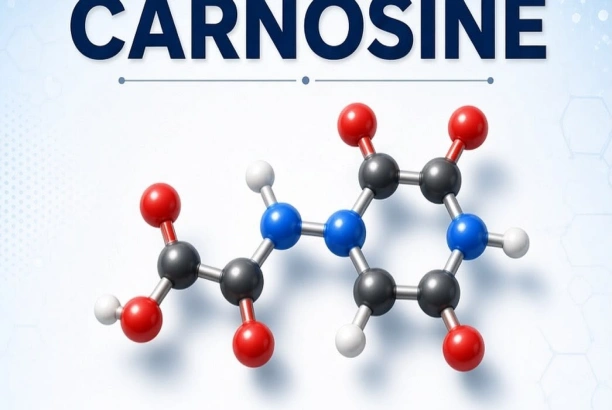
Why L-Carnosine Powder Is Gaining Attention in Functional Food Innovation
What L-Carnosine Is
When beta-alanine forms a connection with L-histidine, a dipeptide known as L-carnosine is produced. This dipeptide is sometimes referred to as beta-alanyl-L-histidine. In the year 1900, researchers discovered it for the first time in beef extract. Later research discovered that it was present in large amounts in the tissue of the brain, heart, and skeletal muscle. Carnosine is a multifunctional chemical that has been associated with pH buffering, antioxidant activity, and protection against reactive carbonyl compounds, according to a study that was published in Physiological Reviews (2013). The presence of such a lengthy study record is the reason why formulators continue to return to it. For a food team, the practical point is straightforward: the molecule has a well-defined chemical identity, a lengthy publishing history, and a number of functional orientations that are in line with the most recent wellness trends.
Technical Data Buyers Should Confirm
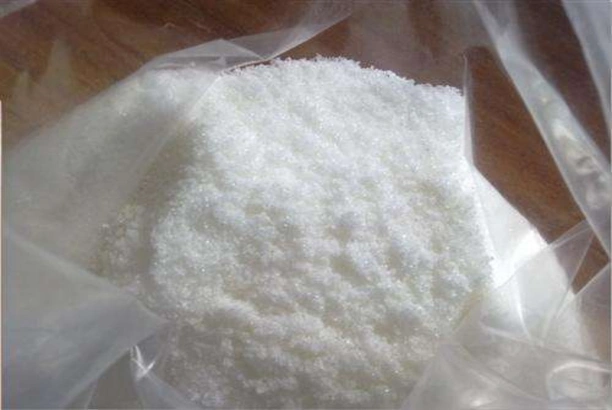
It is highly recommended that you confirm the identification data on the specification sheet before beginning any testing. The L-carnosine produced by Jianbei is a white powder that has been tested by HPLC and has a specification of 98%. C9H14N4O3 is the chemical formula, and the CAS number for this substance is 305-84-0. These numbers are significant in everyday jobs. Assay results and molecular weights that are accurate allow your team to compute the dosage per serving, determine the quantity that should be labelled, and compare batches. The moisture content, residual solvents, and microbiological limitations that are included on each Certificate of Analysis should also be reviewed by purchasers. When a supplier provides unambiguous figures, formulation maths is completed more quickly, and audits are reduced in complexity.
Market Demand Behind the Interest
Because of the growing interest among consumers in healthy ageing, active lifestyles, and premium wellness, businesses are increasingly drawn to ingredients that have a scientific explanation. This trend is consistent with L-carnosine due to the fact that published research has included topics such as glycation chemistry, antioxidant behaviour, and muscular performance. For the purpose of producing capsules, tablets, sachets, beverage premixes, and special OEM items, product teams in the United States look at it. Since anti-glycation is a common issue in both beauty-from-within and topical development, skin health is another busy field that is being developed. Those companies that are looking to create a unique ingredient narrative without venturing into uncharted territory will discover that L-carnosine is a suitable counterpart.
L-Carnosine Powder Benefits and Functional Food Applications
Antioxidant and Anti-Glycation Activity
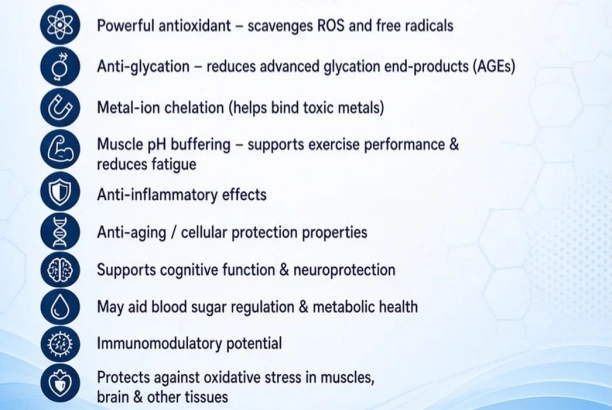
There are a number of potential benefits associated with L-carnosine powder, including the ability to slow the ageing process, improve skin health, and protect cells from injury. Jianbei describes the substance as having antioxidant, anti-glycation, and anti-inflammatory properties. There is a unique scientific basis for anti-glycation methods. The ability of carnosine and similar dipeptides to quench reactive carbonyl species, which are involved in the formation of advanced glycation end-products, was shown in an article that was published in BioFactors in the year 2005. A further description of carnosine as an antioxidant and antiglycating agent may be found in the Science of Ageing Knowledge Environment (2005). When it comes to preparing product claims, I always make sure to keep laboratory discoveries and human evidence separate, and I also recommend that purchasers do the same thing.
Common Product Formats
L-carnosine is water-soluble, which means that it may be used in a wide number of applications. Some examples of these uses are stick packs and beverage premixes. Powder has the capability of delivering the desired effect in capsules and tablets, where the dosage is determined by the fill weight or compression of the capsule or tablet. Powder has the capacity to offer the needed effect. On the market, the categories that are seen the most often are those that include multi-ingredient blends, healthy-aging formulae, and alternatives to sports nutrition. Blends are created when they are combined with other components, such as botanicals, vitamins, minerals, and other amino acids. Blends are created when they are combined with other components. For the purpose of ensuring that every conceivable combination is acceptable for the thing that is being examined, it is necessary to conduct tests of taste, colour, and stability. Before ready-to-drink drinks and gummies can be made on a wider scale, it is important to conduct further pilot tests as part of the qualification process. Therefore, this is due to the fact that these items include both heat and moisture.
Comparison with Beta-Alanine and Finished Capsules
The research that was carried out and published in the Journal of the International Society of Sports Nutrition (2015) suggests that beta-alanine is the precursor that has the most significant impact on the pace at which muscle carnosine is synthesised. This was shown to be the case. As indicated by the findings of a meta-analysis that was published in Amino Acids (2012), beta-alanine was shown to boost exercise performance, with the benefits being most noticeable in efforts that lasted between one and four minutes. This was the conclusion reached by the researchers behind the study. More specifically, carnosine is a distinct chemical entity that has been the subject of its own study investigation into the antioxidant and anti-glycation characteristics. This investigation has been conducted for quite some time. When it comes to powder, you have complete control over the dosage, the mixing, and the packing. On the other hand, when it comes to capsules that have already been manufactured, the format is already decided upon. As a consequence of the fact that structure-function assertions in the United States are required to be accurate, proven, and supported by the FDA disclaimer, it is vital to examine every language with regulatory counsel because of these requirements. Therefore, it is essential to review every language.
Formulating and Quality Control for L-Carnosine Powder
Formulation Variables to Check
After determining the consumer profile, claim constraints, and target market, the next step is to choose the format, serving size, and format. Additionally, it is required to determine the target market. Immediately after that, you need to conduct tests on the many factors that have an impact on performance. Dispersion time, pH compatibility, particle size, sedimentation, and flavour analysis are some of the parameters that are considered here. For each of these chemicals, it is necessary to do research on the potential interactions that might occur between minerals, proteins, botanicals, and sweeteners. There are a variety of factors that may have an effect on the stability of a final product. Some of these factors include heat, moisture, light, oxygen, and compression. All of the following are dependent on the flow and fill accuracy of the capsules: the compression behaviour of tablets, the dissolving and sensory impacts of liquids, and the flow and fill accuracy of the capsules. After pilot studies have been conducted in the exact format that is meant to be utilised, I feel that the final dosage should not be determined until after the pilot studies have been completed.
Quality Documents and Grades
Request that each and every supplier of L-carnosine powder provide you with a current Certificate of Analysis that is particular to the batch in question. This certificate should include the assay, identity, moisture, residual solvents, associated compounds, heavy metals, and microbiological limitations. Because food grade and pharmaceutical grade adhere to separate regulatory requirements and criteria, you should never consider them to be interchangeable. Although micronization alters the size of particles and the flow of particles, it does not inevitably increase purity. L-carnosine produced by Jianbei is subjected to high-performance liquid chromatography (HPLC) testing, and the following certifications are included on our list: Organic Food, Kosher, ISO, HALAL, HACCP, and GMP. A shelf life of two years may be achieved by storing the item in a dry and cold location. Also, buyers should seek allergy, genetically modified organism, and animal-origin disclosures.
Pilot Testing Workflow
Launch danger may be reduced by using a controlled route. Initial steps include determining the regulatory category, type, serving size, claims, and papers that are necessary. Comparing the samples in terms of their purity, appearance, solubility, taste, and flowability is the second step. Third, conduct trial batches and evaluate the blend's homogeneity, filling accuracy, compression, dissolution, sensory performance, and compatibility with the packaging. The fourth step is to conduct stability studies that take into account the anticipated conditions of temperature, humidity, light, and transportation. Lastly, the specification, the requirements of the COA, the release criteria, and the change-control processes should be locked. Keep monitoring the performance of both the batch and the supplier after the launch to identify any modest changes as soon as possible.
Bulk Buying and Supplier Evaluation for L-Carnosine Powder
Supplier Evaluation Criteria
When it comes to dependability, a quote doesn't tell you much. I look for specs that are easy to understand, batch quality that is consistent, technical assistance that is prompt, capacity that is steady, export documentation that is complete, and complaint processes that are well described. Although distributors and trading organisations may provide regional inventory and sourcing flexibility, distributors and manufacturers have direct control over production. Therefore, it is important to verify the location of the real manufacturing site. Certificates, audit reports, and licenses pertaining to GMP, ISO, and HACCP should be reviewed. On the premises of Jianbei Biotechnology Co., Ltd. is a manufacturing facility that has three production lines, a workshop that adheres to GMP standards, and two independent labs. In addition to the 15 national innovation patents, our team at Guangzhou Software Park also has eight utility model patents, which cover both fundamental processes and intelligent monitoring systems.
Order Terms and Logistics
Time is saved by term clarity. Our shipping time ranges from three to seven business days following payment, and our minimum order amount is one kilogram. Among the payment methods that we accept are Western Union, Alipay, XT, and telegraphic transfers. There is a choice between a 25-kilogram drum or a 1-kilogram bag made of aluminium foil. Only exports are permitted for the powder. Due to the fact that freight, paperwork, and lead time all have an impact on the actual value, it is more accurate to compare the total landed cost rather than the price per kilogram.
Innovation Trends and Long-Term Partnerships
The creation of products is shifting away from single-ingredient goods and toward multifunctional formulations that contain antioxidants, amino acids, vitamins, minerals, and botanicals together with other components. Compatibility, stability, sensory quality, and claims are all areas that need to be thoroughly examined for these compositions. Demand is also increasing for application-specific grades, such as high-purity materials that are compatible with beverages or materials with a particle size that is customised. A growing number of procurement teams are evaluating suppliers based on overall value, which includes documentation, technical assistance, and delivery performance. Sharing of forecasts, yearly quality evaluations, and help for scaling up are all examples of what might be included in long-term collaborations.

Conclusion
L-carnosine powder contains L-carnosine, a dipeptide of beta-alanine and L-histidine with a long research record in antioxidant activity, anti-glycation chemistry, and muscle physiology. Its value in functional food innovation depends on matching the ingredient to the format. Water solubility, particle size, taste, and stability all need testing in capsules, tablets, sachets, or beverages. Purity and identity data, including assay, CAS number, and molecular weight, support accurate dosing and labeling. Batch COAs and clear grade definitions separate dependable materials from uncertain ones. Beta-alanine and carnosine are distinct ingredients, and all claims need substantiation under local rules. Supplier selection works best when it weighs certifications, manufacturing control, lead time, order terms, and total landed cost, followed by sampling, pilot production, and stability testing.
FAQ
1. What is L-carnosine powder used for?
Brands use it in supplements, sports nutrition, healthy-aging formulas, and functional food research. Allowed claims depend on regional regulations.
2. How should I store it?
Keep it sealed in a dry, cool place. Under these conditions, the shelf life is two years.
3. What are the order terms?
The minimum order is 1 kg, and delivery takes 3–7 working days after payment. Packaging is a 1 kg aluminum foil bag or a 25 kg drum. We accept telegraphic transfer, Alipay, XT, PayPal, and Western Union.
Contact Jianbei for L-Carnosine Powder Manufacturer Support
Jianbei Biotechnology Co., Ltd. supplies 98% L-carnosine powder from a GMP workshop with three production lines and two independent laboratories. Orders start at 1 kg, and delivery takes 3–7 working days after payment. As an L-carnosine powder manufacturer, we export only. Email sales@bqingbio.com with your product format, annual volume, and destination.
References
1. Physiological Reviews, 2013 – Physiology and Pathophysiology of Carnosine
2. Advances in Food and Nutrition Research, 2009 – Carnosine and Its Possible Roles in Nutrition and Health
3. BioFactors, 2005 – Carnosine and Related Dipeptides as Quenchers of Reactive Carbonyl Species
4. Science of Aging Knowledge Environment, 2005 – Carnosine: A Versatile Antioxidant and Antiglycating Agent
5. Amino Acids, 2012 – Effects of Beta-Alanine Supplementation on Exercise Performance: A Meta-Analysis
6. Journal of the International Society of Sports Nutrition, 2015 – International Society of Sports Nutrition Position Stand: Beta-Alanine