- English
- French
- German
- Portuguese
- Spanish
- Russian
- Japanese
- Korean
- Arabic
- Greek
- German
- Turkish
- Italian
- Danish
- Romanian
- Indonesian
- Czech
- Afrikaans
- Swedish
- Polish
- Basque
- Catalan
- Esperanto
- Hindi
- Lao
- Albanian
- Amharic
- Armenian
- Azerbaijani
- Belarusian
- Bengali
- Bosnian
- Bulgarian
- Cebuano
- Chichewa
- Corsican
- Croatian
- Dutch
- Estonian
- Filipino
- Finnish
- Frisian
- Galician
- Georgian
- Gujarati
- Haitian
- Hausa
- Hawaiian
- Hebrew
- Hmong
- Hungarian
- Icelandic
- Igbo
- Javanese
- Kannada
- Kazakh
- Khmer
- Kurdish
- Kyrgyz
- Latin
- Latvian
- Lithuanian
- Luxembou..
- Macedonian
- Malagasy
- Malay
- Malayalam
- Maltese
- Maori
- Marathi
- Mongolian
- Burmese
- Nepali
- Norwegian
- Pashto
- Persian
- Punjabi
- Serbian
- Sesotho
- Sinhala
- Slovak
- Slovenian
- Somali
- Samoan
- Scots Gaelic
- Shona
- Sindhi
- Sundanese
- Swahili
- Tajik
- Tamil
- Telugu
- Thai
- Ukrainian
- Urdu
- Uzbek
- Vietnamese
- Welsh
- Xhosa
- Yiddish
- Yoruba
- Zulu
Pregabalin is a drug that holds an important position in the treatment of neuropathic pain and other fields. Its research and development background is closely related to the neurotransmitter gamma-aminobutyric acid (GABA). GABA, as a key neurotransmitter in the human body, acts on GABA receptors and is crucial for maintaining the normal physiological state of the human body. When the human body lacks GABA, it can cause negative emotions such as anxiety, fatigue and worry. In the 1980s, the Silverman Laboratory focused on the research of GABA transaminase. The main function of GABA-AT is to degrade GABA. AT that time, Silverman's initial idea was to synthesize a series of GABA analogues, hoping to use them as inhibitors of GABA-AT, and then screen out compounds from them that could be used to treat anticonvulsions, Parkinson's disease, Alzheimer's disease and Huntington's disease.
Epilepsy, as a common and complex neurological disorder, is also closely associated with GABA. Epilepsy is a disease characterized by recurrent convulsive seizures, and its causes are diverse. Although studies have shown that direct injection of GABA into the brain can terminate epileptic seizures, oral administration and intravenous injection of GABA do not achieve the same effect. This is because GABA is a highly polar and charged small molecule compound, which is difficult to penetrate the blood-brain barrier and enter the brain to exert its functions. Therefore, developing GABA analogues with stronger liposolubility to enable them to smoothly pass through the blood-brain barrier has become an important research direction for the treatment of epilepsy.
From 1980 to 1988, the Silverman laboratory continuously designed and synthesized GABA-AT inhibitors in accordance with the established ideas. However, unfortunately, these compounds have relatively weak selectivity for GABA-AT and also show inhibitory effects on L-glutamic acid decarboxylase (GAD). GAD is precisely the key enzyme responsible for the production of GABA, which leads to these compounds not only inhibiting the decomposition of GABA but also hindering its generation, clearly not meeting the standards of an ideal drug. In 1988, research witnessed a significant turning point. Postdoctoral fellow Ryszard Andruszkiewicz in the Silverman group synthesized seven 3-alkyl GABAs.
Subsequently, Ryszard tested these compounds separately for their effects on GABA-AT and GAD. The results showed that they had only a weak inhibitory effect on GABA-AT. But surprisingly, these compounds have an activating effect on GAD, which means they can increase the level of GABA in the body. Despite achieving the goal of increasing GABA levels, Silverman realized that the root cause of research failures over the years was the incorrect selection of GABA-AT as a target, and the newly synthesized compounds with positive effects were actually not effectively associated with the originally set target, and the actual target that worked might be GAD.
There is also a puzzling issue in the research process, that is, the compound (R) -3-methylGABA, which has the strongest GAD activation, is not as effective as (S) - (+) -3-isobutyl GABA. Scientists are conducting in-depth research on this. In this process, it is necessary to mention another marketed drug - gabapentin. Gabapentin was approved by the US FDA in 1993 for the treatment of epilepsy. It is also an analog of GABA and has an activating effect on GAD. In 1996, Parke Davis scientists discovered the target of gabapentin, which acts on the α 2- σ subunit protein of voltage dependent calcium channels in the central nervous system (CNS). By inhibiting this protein, it reduces depolarization and Ca ² ⁺ influx into nerve endings, thereby reducing the release of excitatory neurotransmitters such as glutamate, norepinephrine, substance P, and calcitonin gene-related peptide (CGRP). Research has shown that pregabalin also works through a similar mechanism. At this point, the truth gradually became clear, and it turned out that the true target of Pregabalin was not related to the initially studied GABA-AT and GAD.
synthetic route
Using isovaleraldehyde and ethyl cyanoacetate as raw materials, (Z) -2-cyano-5-methyl-2-en-hexanoic acid ethyl ester is synthesized through Knoevenagel condensation. It then undergoes Michael addition and hydrolysis decarboxylation with diethyl malonate to form 3-isobutyl glutaric acid, which is dehydrated and cyclized with acetic anhydride to form 3-isobutyl glutaric anhydride. The latter is hydrolyzed in ammonia to form 3-aminoformylmethyl monomethyl hexanoic acid. Hofmann rearrangement is carried out to obtain racemic pregabalin, which is finally separated by S-mandelic acid to obtain pregabalin The optical purity is 99.8%
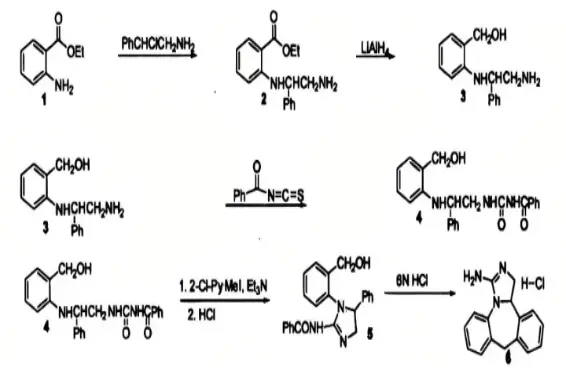
Since Pregabalin was approved by the European Union for the treatment of some epileptic seizures in 2004 and by the US FDA for the relief and treatment of various neuropathic pains in 2005, its application scope has continued to expand. In the treatment of diabetes peripheral neuropathy neuralgia (DPN) and post herpetic neuralgia (PHN), pregabalin is the first drug approved by the US FDA, which brings hope for pain relief to many patients. With the deepening of research on it, pregabalin has also shown good therapeutic effects in fields such as spinal cord injury related neuropathic pain and fibromyalgia related neuropathic pain. In addition, pregabalin plays an important role in the treatment of partial seizures in patients aged 4 and above, becoming one of the best-selling analgesics currently available.