- English
- French
- German
- Portuguese
- Spanish
- Russian
- Japanese
- Korean
- Arabic
- Greek
- German
- Turkish
- Italian
- Danish
- Romanian
- Indonesian
- Czech
- Afrikaans
- Swedish
- Polish
- Basque
- Catalan
- Esperanto
- Hindi
- Lao
- Albanian
- Amharic
- Armenian
- Azerbaijani
- Belarusian
- Bengali
- Bosnian
- Bulgarian
- Cebuano
- Chichewa
- Corsican
- Croatian
- Dutch
- Estonian
- Filipino
- Finnish
- Frisian
- Galician
- Georgian
- Gujarati
- Haitian
- Hausa
- Hawaiian
- Hebrew
- Hmong
- Hungarian
- Icelandic
- Igbo
- Javanese
- Kannada
- Kazakh
- Khmer
- Kurdish
- Kyrgyz
- Latin
- Latvian
- Lithuanian
- Luxembou..
- Macedonian
- Malagasy
- Malay
- Malayalam
- Maltese
- Maori
- Marathi
- Mongolian
- Burmese
- Nepali
- Norwegian
- Pashto
- Persian
- Punjabi
- Serbian
- Sesotho
- Sinhala
- Slovak
- Slovenian
- Somali
- Samoan
- Scots Gaelic
- Shona
- Sindhi
- Sundanese
- Swahili
- Tajik
- Tamil
- Telugu
- Thai
- Ukrainian
- Urdu
- Uzbek
- Vietnamese
- Welsh
- Xhosa
- Yiddish
- Yoruba
- Zulu
When working with jinyang alkali powder in pharmaceutical synthesis or nutraceutical manufacturing, one variable consistently determines whether your formulation performs or falls short — particle size. This single physical characteristic governs how quickly the active compound dissolves, how uniformly it distributes across a blend, and how reliably it delivers results batch after batch. Understanding why particle size matters in Jinyang alkali powder applications is not academic; it is a practical procurement and formulation decision that shapes product quality, regulatory compliance, and downstream manufacturing efficiency.
Understanding Particle Size and Its Role in Jinyang Alkali Powder
What Particle Size Actually Means in Powder Chemistry
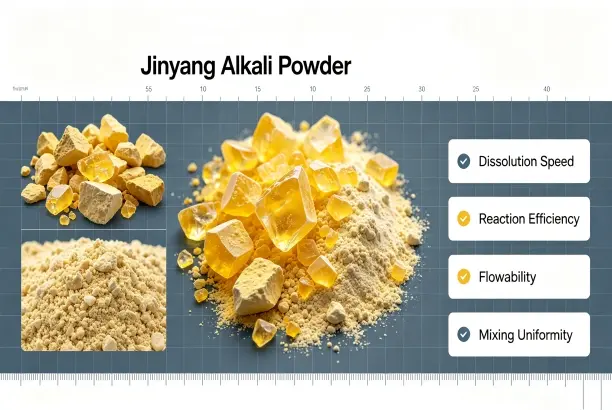
Particle size is the observed width of each powder granule, which is usually given in micrometers (µm). Particle Size Distribution (PSD) research is used to make sure that a lot of pharmaceutical-grade powders meet the requirements for uniformity. Jinyang alkali powder is a fine yellow powder with the molecular formula C₂₂H₃₀N₆O₄S·C₆H₈O₇, a molecular weight of 666.7, and the CAS ID 171596-41-1. The particle uniformity of this chemical directly impacts how it works with other substances, solvents, and living systems. Each batch of products from Jianbei's GMP-certified workshop goes through PSD analysis as well as heavy metal and microbe tests to make sure they are all the same.
How Particle Size Influences Chemical Behavior and Reaction Rate
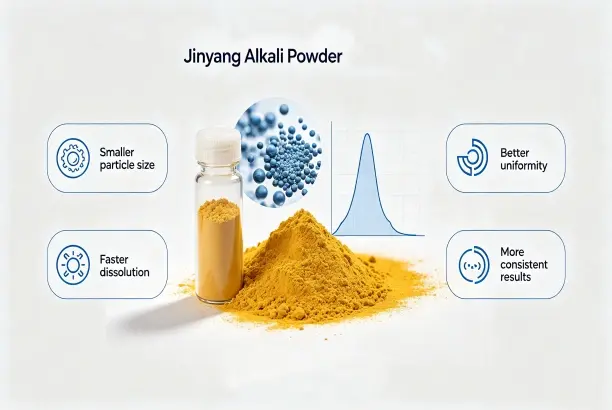
Smaller particles have a bigger overall surface area compared to their mass, which speeds up breakdown and helps mix the particles evenly. When making solid dosage forms like capsules and tablets, the spread of small particles makes sure that the micro-dosing stays uniform even when the product is compressed under high pressure. On the other hand, particles that are too small can make electrostatic attraction and clumping worse, which can make powder flow more difficult during automated filling. So, getting the right mix of particle sizes is not just a quality test but also a decision made by formulation engineers.
In functional applications, particle size also affects how chemicals react with each other. When it comes to quality-controlled settings, a powder with a narrower PSD works more consistently. This means that there is less variation between production runs and claims of stable effectiveness across product batches.
Why Particle Size Impacts Efficiency and Safety in Applications
Dissolution Speed and Bioavailability
It can be measured that fine particles dissolve faster than coarse granules. It is well known in pharmaceutical science that decreasing particle size from 200 µm to 50 µm can speed up dissolving by a factor of 4. This is based on early studies into pharmaceutical solubility. In liquid forms that use jinyang alkali powder, like functional drinks or alcohol-based tinctures, faster dissolution means a clearer, sediment-free composition and consumer acceptance. Because fine-particle grades of the compound dissolve more easily in organic solvents like ethanol, they work best for these delivery systems.
Safety Considerations in Powder Handling
The size of the particles also has a direct effect on worker safety. When very fine powders are weighed, mixed, or moved, dust is released into the air. In GMP settings like Jianbei's production plant, strict handling rules are the norm. These rules include protected serving systems and the right to respiratory protection. The company has three production lines and two separate quality labs. These are set up to keep cross-contamination and dust contact to a minimum while products are being made. When people buy from a compliant producer, they not only get safer materials, but the company also makes sure that the supply chain is safe for everyone involved.
Comparing Jinyang Alkali Powder Particle Sizes with Other Alkali Powders
Particle Size Distribution Versus Sodium Hydroxide and Quicklime
Traditional alkaline materials, such as sodium hydroxide (NaOH) and quicklime (CaO), are used a lot in industry. However, managing the particles that these materials contain is still a problem. For example, the particle distributions in quicklime are very different, which makes it hard to get the right dose for sensitive uses. You can get sodium hydroxide in the form of flakes or pellets. It needs to be dissolved, which adds more factors to the process.
Jinyang alkali powder is clearly better in this case. The fine yellow powder form, which has been tested by HPLC and standardized to 98% specifications, has a tightly controlled particle profile that makes it ideal for use in pharmaceutical and nutraceutical products. When manufacturers get this compound, they get consistent blending that coarser industrial alkalis can't match in situations where accuracy is important.
Environmental and Cost Efficiency Through Optimized Particle Size
Optimized particle size cuts down on waste. When dissolution efficiency goes up, manufacturers need less active ingredient per batch to get the desired result. This lowers the cost of raw materials and the amount of wastewater that needs to be cleaned up. For businesses that have to follow international rules, this is especially important. For example, FDA, HACCP, ISO, HALAL, and KOSHER certifications all require strict controls on quality and waste. All of these standards have been met by Jianbei's alkali powder, making it a sustainable and audit-ready source.
How to Choose the Right Particle Size of Jinyang Alkali Powder for Your Industry Needs
Matching Particle Grade to Application Requirements
Particle size profiles need to be different for each industry. Procurement managers who know this difference can make better decisions about where to source materials. Here are the main parts of the application you should think about:
- Solid dosage manufacturing (capsules, tablets): Fine particle grades are best because they mix easily with excipients and maintain dose accuracy when compressed. The low moisture content of jinyang alkali powder helps keep tablets solid and stable on the shelf.
- Liquid functional formulations (beverages, tinctures): Fine grades break down easily in ethanol-based solvents, making clear, stable end products that meet the needs of both consumers and regulators. Particle size has a direct effect on how quickly the particles dissolve and how clear the solution is.
- Concentrated botanical blends and herbal powders: Moderate particle sizes work well here, bridging the gap between old-fashioned herbal delivery methods and current drug standards. The powder stays stable in high-humidity storage, which is common in global supply chains, and it mixes easily into complex plant mixtures.
These differences are most important when judging a supplier's skills. If a supplier only has one standard grade, they can't support different formulations across product lines.
Supplier Evaluation, MOQ, and Packaging Integrity
There are more things to think about than just price per kilogram when choosing a supplier. During transportation, packaging has a direct effect on the stability of the particles. Jianbei ships in either 1 kg aluminum foil bags or 25 kg drums. Both of these forms keep the fine particle structure by stopping the particles from absorbing water and getting damaged by compression. As low as 1 kg is needed to place an order, which lets research and development teams test how well the particles work at a small scale before committing to larger production amounts.
Delivery takes between 3 and 7 business days after payment is confirmed. Telegraphic transfer, Alipay, PayPal, and Western Union are all flexible ways to pay, which can work for foreign buyers in many areas. A sealed product that is kept in a cool, dry place will keep its full potency for two years.
Best Practices and Case Studies Showcasing Particle Size Optimization
Case Study: Functional Beverage Clarity Improvement
A functional beverage brand that was changing the way a liquid health product was made said that early batches were still cloudy and had sediment in them. The main reason was found to be the way the small particles were distributed in the active powder part. After making the change to a fine-grade pharmaceutical powder with confirmed PSD, it only took two weeks for the formulation team to achieve uniform clarity. The uniformity of dissolution improved, and the product passed the food safety compliance screening without having to go through any extra steps of filtration.
Case Study: Tablet Compression Uniformity in Nutraceutical Manufacturing
A medium-sized nutraceutical company that made encapsulated supplements had weight differences of more than ±5% between batches, which led to quality control problems inside the company. PSD research showed that the raw material had particles of different sizes. The difference was fixed by setting a narrower particle size range, which was confirmed by HPLC and PSD tests before shipping. The weight difference between subsequent runs was less than ±1.5%, which met GMP compliance standards and was supported by FDA registration paperwork.
A simple rule is strengthened by these results: particle size is not a secondary specification. It is a key performance indicator that has direct effects on costs and compliance.
Procurement checklist for particle size sourcing decisions:
- Confirm PSD analysis is included in the certificate of analysis (COA)
- Verify HPLC purity at ≥98% for active compound content of jinyang alkali powder
- Ask the supplier for records of batch-to-batch consistency
- Make sure the style of the package protects the particles' integrity during shipping
- Validate that storage and shelf-life conditions align with your warehouse environment
Conclusion
Particle size affects all the important parts of powder formation, like how quickly it dissolves, how uniform it is, how safe it is, and how well it meets compliance standards. Picking the right grade of jinyang alkali powder is not a guessing game; it is based on data from PSD analysis, HPLC testing, and the needs of the application. Jianbei Biotechnology offers pharmaceutical-grade powder with the consistent particle size that precise formulation needs. Their production is GMP-certified; they have 15 national invention patents, and they have a full suite of international certifications. If the performance of your raw materials is important for your product, particle size is where that dependability starts.
FAQ
1. What particle size range does Jinyang alkali powder typically fall within?
Particle Size Distribution (PSD) analysis is done in-house at Jianbei to check the quality of each production batch. While exact ranges are confirmed by the batch COA, the fine yellow powder form of Jinyang alkali powder is designed to be compatible with pharmaceutical homogenization and dissolution.
2. How does particle size affect HPLC purity results?
The particle size doesn't change the chemicals, but it does change how samples are prepared for laboratory tests. Fine particles that are all the same dissolve more completely in the mobile phase. This makes HPLC purity readings less variable and the assay more reliable across multiple analyzes.
3. What is the shelf life, and does particle size affect it?
The product stays fully active for two years if it is kept in its original box and kept in a cool, dry place. Finer particles are more likely to absorb water if the package is damaged, so the best way to store them is in airtight metal foil bags.
4. Is this product available for international export?
You can only export the powder, and you'll get it 3–7 business days after you pay for it. It has certificates from the FDA, ISO, HALAL, KOSHER, HACCP, and GMP, which show that it follows foreign rules.
Source Your Next Batch from Jianbei — A Trusted Jinyang Alkali Powder Manufacturer
Jianbei Biotechnology sells jinyang alkali powder that is GMP-certified, HPLC-verified, and has a uniform particle size. It also has full international certification. It's easy to start with a sample because the minimum order is only 1 kg, delivery is quick (3–7 days), and there are several ways to pay. Email sales@bqingbio.com to ask for a COA, talk about special requirements, or place your order right now.
References
1. Journal of Pharmaceutical Sciences — Particle Size and Its Influence on Dissolution Rate and Bioavailability, 2018.
2. International Journal of Pharmaceutics — Particle Size Distribution Analysis in Solid Dosage Form Development, 2020.
3. Pharmaceutical Technology — GMP Compliance in Powder Manufacturing Processes, 2019.
4. Drug Development and Industrial Pharmacy — PDE5 Inhibitor Structural Analogs: Physicochemical Properties and Formulation Considerations, 2021.
5. Journal of Controlled Release — Surface Area and Dissolution Kinetics in Pharmaceutical Powders, 2017.
6. Regulatory Toxicology and Pharmacology — International Compliance Standards for Active Pharmaceutical Ingredient Suppliers, 2022.