- English
- French
- German
- Portuguese
- Spanish
- Russian
- Japanese
- Korean
- Arabic
- Greek
- German
- Turkish
- Italian
- Danish
- Romanian
- Indonesian
- Czech
- Afrikaans
- Swedish
- Polish
- Basque
- Catalan
- Esperanto
- Hindi
- Lao
- Albanian
- Amharic
- Armenian
- Azerbaijani
- Belarusian
- Bengali
- Bosnian
- Bulgarian
- Cebuano
- Chichewa
- Corsican
- Croatian
- Dutch
- Estonian
- Filipino
- Finnish
- Frisian
- Galician
- Georgian
- Gujarati
- Haitian
- Hausa
- Hawaiian
- Hebrew
- Hmong
- Hungarian
- Icelandic
- Igbo
- Javanese
- Kannada
- Kazakh
- Khmer
- Kurdish
- Kyrgyz
- Latin
- Latvian
- Lithuanian
- Luxembou..
- Macedonian
- Malagasy
- Malay
- Malayalam
- Maltese
- Maori
- Marathi
- Mongolian
- Burmese
- Nepali
- Norwegian
- Pashto
- Persian
- Punjabi
- Serbian
- Sesotho
- Sinhala
- Slovak
- Slovenian
- Somali
- Samoan
- Scots Gaelic
- Shona
- Sindhi
- Sundanese
- Swahili
- Tajik
- Tamil
- Telugu
- Thai
- Ukrainian
- Urdu
- Uzbek
- Vietnamese
- Welsh
- Xhosa
- Yiddish
- Yoruba
- Zulu
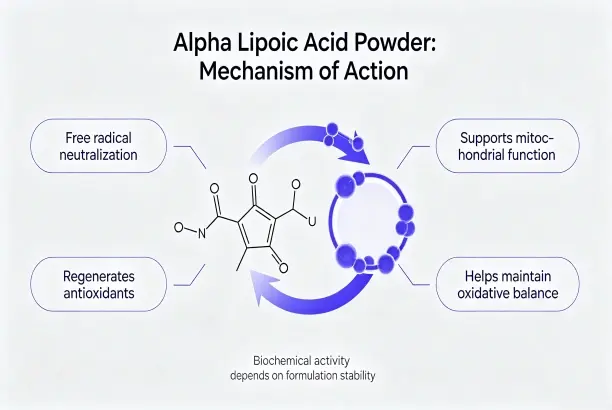
Alpha lipoic acid powder sits at the center of modern nutraceutical, cosmetic, and pharmaceutical formulation — and for good reason. As a "universal antioxidant," this light yellow crystalline powder (CAS: 62-46-4, molecular formula C8H14O2S2) neutralizes free radicals in both water-soluble and fat-soluble environments. Yet its most underestimated challenge isn't sourcing — it's stability. For R&D directors, product managers, and procurement specialists, understanding how thioctic acid behaves under real-world conditions is essential to protecting both formulation integrity and commercial investment.
Understanding Alpha Lipoic Acid Powder and Its Stability Issues
Alpha lipoic acid powder is scientifically defined by its 1,2-dithiolane ring structure. It has a disulfide bond that makes it naturally reactive and gives it great protective power. Because it has a molecular weight of 206.33 g/mol and a melting point between 60 and 62°C, even small amounts of heat during processing can cause it to break down before it gets to the customer.
Why Stability Matters in B2B Formulation
Stability affects how well a product works, how long it lasts, and how well it meets legal requirements. When ALA breaks down, the powder changes color from pale yellow to amber or brown, which is a clear sign that its effectiveness has been lost. Supplement brands and food companies that have to follow FDA or GMP rules can have trouble with batch inconsistency because of instability. This can lead to compliance issues and expensive reformulation cycles. A standard for 98% purity, confirmed by HPLC, is only useful if the purity stays the same throughout the whole duration of the product.
The Four Core Environmental Triggers
The 1,2-dithiolane ring in ALA is very sensitive to oxidant and heat stress. The four main things that speed up environmental degradation are:
- Heat: When temperatures rise above 60°C, ring-opening polymerization starts, which changes bioactive monomers into inactive polymer chains.
- Light: UV and visible light speed up photodegradation, making sulfurous chemicals that change the smell and the way it works.
- Moisture: Adding water makes the disulfide bond more likely to break, which lowers the test values over time in a way that can be measured.
- Oxygen: Oxygen in the air starts reactive chain reactions, especially when packaging is open or not packed well enough.
These four things rarely happen by themselves; when they work together, they speed up power loss much more than any one of them could by itself. Because of this linked weakness, buying teams need to check not only the quality of the raw materials, but also the whole cold chain, from making the goods to using them.
Key Challenges in ALA Stability — A Bottleneck-Breaking Approach
To keep thioctic acid stable throughout the supply chain, formulators have to deal with a number of scientific and operational problems that keep coming up. Alpha lipoic acid powder stability remains the primary focus of these technical investigations.
Chemical Degradation Pathways
The main way that the dithiolane ring breaks down is through heat-catalyzed polymerization, which can't be undone under normal processing conditions. Another way is through oxidative dimerization, which happens when ALA that has been dissolved is exposed to transition metal ions. This is a problem that is especially important in cosmetics and drinks that are liquid. A study in the Journal of Pharmaceutical Sciences shows that racemic ALA (RS-ALA) is slightly less stable than the R(+) enantiomer under the same stress conditions. This is an important difference to keep in mind when choosing raw materials for high-end products.
Problems with analysis make the situation worse. Standard HPLC testing, which is the standard way to check for 98% specification ALA, can find a drop in measurement but might miss early-stage polymerization if particle size distribution and optical rotation are not also monitored. Teams in charge of buying things should ask for COAs with more than just pure numbers.
Some strategies for reducing damage that have been shown to work in the real world include controlling pH (keeping aqueous systems slightly acidic between 4.5 and 6.0), combining chelating agents like EDTA to stop metal ion catalysts from working, and using antioxidants like ascorbic acid or tocopherols to stop oxidative chain reactions.
Formulation Solutions and Innovations to Enhance Stability
There is a big difference between traditional and advanced alpha lipoic acid powder formulations. Standard powder mixes with common excipients are useful, but they don't protect well against the above degradation processes.
Microencapsulation and Protective Technologies
Microencapsulation, which involves covering ALA particles with things like hydroxypropyl methylcellulose (HPMC), cyclodextrin inclusion complexes, or lipid-based matrices, keeps oxygen and water away from the active compound. Studies have shown that cyclodextrin-encapsulated ALA keeps more than 95% of its effectiveness after six months of rapid stability testing at 40°C/75% RH, while uncoated material only keeps about 78% of its effectiveness under the same conditions. This is a big difference for pill brands that put claims on their labels.
Nanotechnology-based transport methods, such as solid lipid nanoparticles and nanostructured lipid carriers, have two benefits: they make the drug more bioavailable by letting more molecules pass through the membrane, and they keep the drug stable for longer by protecting it from physical barriers. For people who are making anti-aging serums or antioxidant skin care, these tools make it possible to add ALA in stable amounts that are medically useful, without having to worry about the powder settling or changing color.
Excipient selection is also important. Avoiding fillers that contain leftover peroxides (common in some types of polyethylene glycol) and choosing fillers with low moisture content greatly increases the shelf life. When blending, granulating, or encapsulating, the processing temperature should stay 40 °C below as much as possible.
Procurement Insights for Stable ALA Powder — Demand Matching Approach
For informed buying of alpha lipoic acid powder to work, there needs to be more than just price per kilogram used to judge suppliers. When making decisions about buying in bulk, the following things show if a supplier can safely provide stable material:
- Purity specification and testing method: Demand an assay that is ≥98% HPLC-verified and comes with a proof of analysis that covers heavy metals, microbial limits, and leftover solvents.
- Packaging integrity: Pharmaceutical-grade ALA should not be put in regular polyethylene bags, but in 1 kg aluminum foil bags or 25 kg sealed drums that really keep out moisture and air.
- Cold chain documentation: Suppliers should give stability data that was generated in real storage conditions, not just results from stress tests that were run faster.
- Certifications: FDA registration, GMP compliance, ISO, HALAL, KOSHER, HACCP, and organic certifications signal a seller's commitment to quality processes rather than one-time testing.
The difference between powder and capsule form has real effects on longevity. When buying powder in bulk, you have more options for how to make the mix, but you have to be more careful about how you store it. The usual two-year shelf life can be safely extended by storing the food in a sealed environment that is dry and cool. However, buyers must check the warehouse conditions at both the supplier's and their own receiving facilities to do this.
It's also important for businesses to know the difference between manufactured (RS-ALA) and biological (R(+)-ALA). RS-ALA is the most common type sold in stores, and it can be used in most food and vitamin products. The naturally occurring enantiomer, R(+)-ALA, commands a higher price and is preferred in pharmaceutical and high-end nutraceutical uses where proven biological activity is a key part of the product's value.
Managing Stability Risks — How to Avoid Common Pitfalls
In production, stability problems rarely come from a single point of failure. They build up over time because of a number of small mistakes regarding alpha lipoic acid powder handling, such as inconsistent checks of suppliers, inadequate storage temperature logs, non-compliant packing substitutions during shortages of supplies, or inadequate testing of new quality control.
Most operations make the mistake of depending on the supplier's COA without doing their own receiving verification. An HPLC repeat upon receipt, along with an eye check for discoloration or clumping, finds breakdown events that happened during transport. Contractual clauses that spell out the rights to retesting and the criteria for rejecting a batch keep procurement teams from having to pay for damaged goods.
Instead of assuming, the temperature in the warehouse should be actively checked. Even in places with mild weather, ALA stored near loading docks or under skylights can be damaged by sudden temperature changes in the summer. The minimum standard for keeping specifications intact for the full two-year shelf life is a sealed aluminum package in a controlled storage setting with a temperature below 25°C and a relative humidity below 60%.
Conclusion
Managing the stability of alpha lipoic acid powder in formulation is a difficult task that involves science, processing, packing, and the supply chain. Professionals in procurement who know how products break down and choose providers who do the right thing by using GMP production, strict testing, and compliant packaging can protect both the quality of the product and the reputation of the brand. It is essential for sustainable product development to work with suppliers whose infrastructure is certified, whose stability data has been checked, and whose paperwork is ready for export.
FAQ
1. How do I verify supplier quality for ALA powder?
Ask for a full certificate of analysis that includes the HPLC test, the amount of heavy metals, the limits for microbes, and any solvents that are still present. Check the supplier's GMP, FDA, and ISO approvals against each other. Do a separate incoming HPLC retest on each batch of alpha lipoic acid powder to make sure the standard fits the COA.
2. What is the expected shelf life under ideal storage conditions?
ALA powder has a 98% shelf life if it is kept in sealed containers in a dry, cool place below 25°C and out of direct light and humidity for two years. The shield protection that is needed for this can be found in aluminum foil bags and drums that are sealed.
3. Is organic or synthetic ALA more stable?
The most common industrial grade is RS-ALA, which comes in a synthetic racemic form and is stable under normal circumstances. The naturally occurring form of ALA, R(+)-ALA, may have slightly different stability patterns in some water-based products. Proper packing, controlled storage, and handling at low temperatures are good for both.
4. What certifications should a reliable ALA supplier hold?
FDA registration is a must, along with GMP, ISO, HACCP, and HALAL or KOSHER if your target market requires it. All of these certifications show that the manufacturing quality, safety controls, and ability to export are all good.
Partner with Jianbei for Certified Alpha Lipoic Acid Powder
Jianbei Biotechnology makes alpha lipoic acid powder that is good enough to export. Their production is GMP-certified, and their purity is 98% HPLC-verified. They also have full certifications from FDA, ISO, HALAL, KOSHER, and HACCP. Jianbei can help you reach your formulation goals with a steady supply of high-quality ingredients and two independent labs. Their minimum order quantity (MOQ) is as low as 1 kg, and they deliver within 3–7 business days. To get a sample or bulk quote, email us at sales@bqingbio.com.
References
1. Biewenga, G. P., Haenen, G. R., & Bast, A. (1997). The pharmacology of the antioxidant lipoic acid. General Pharmacology: The Vascular System, 29(3), 315–331.
2. Goraca, A., Huk-Kolega, H., Piechota, A., Kleniewska, P., Ciejka, E., & Skibska, B. (2011). Lipoic acid – biological activity and therapeutic potential. Pharmacological Reports, 63(4), 849–858.
3. Shay, K. P., Moreau, R. F., Smith, E. J., Smith, A. R., & Hagen, T. M. (2009). Alpha-lipoic acid as a dietary supplement: Molecular mechanisms and therapeutic potential. Biochimica et Biophysica Acta (BBA) – General Subjects, 1790(10), 1149–1160.
4. Packer, L., Witt, E. H., & Tritschler, H. J. (1995). Alpha-lipoic acid as a biological antioxidant. Free Radical Biology and Medicine, 19(2), 227–250.
5. Carlson, D. A., Smith, A. R., Fischer, S. J., Young, K. L., & Packer, L. (2007). The plasma pharmacokinetics of R-(+)-lipoic acid administered as sodium R-(+)-lipoate to healthy human subjects. Alternative Medicine Review, 12(4), 343–351.
6. United States Pharmacopeia (USP). (2023). Alpha Lipoic Acid Monograph. USP–NF, USP Publications.